


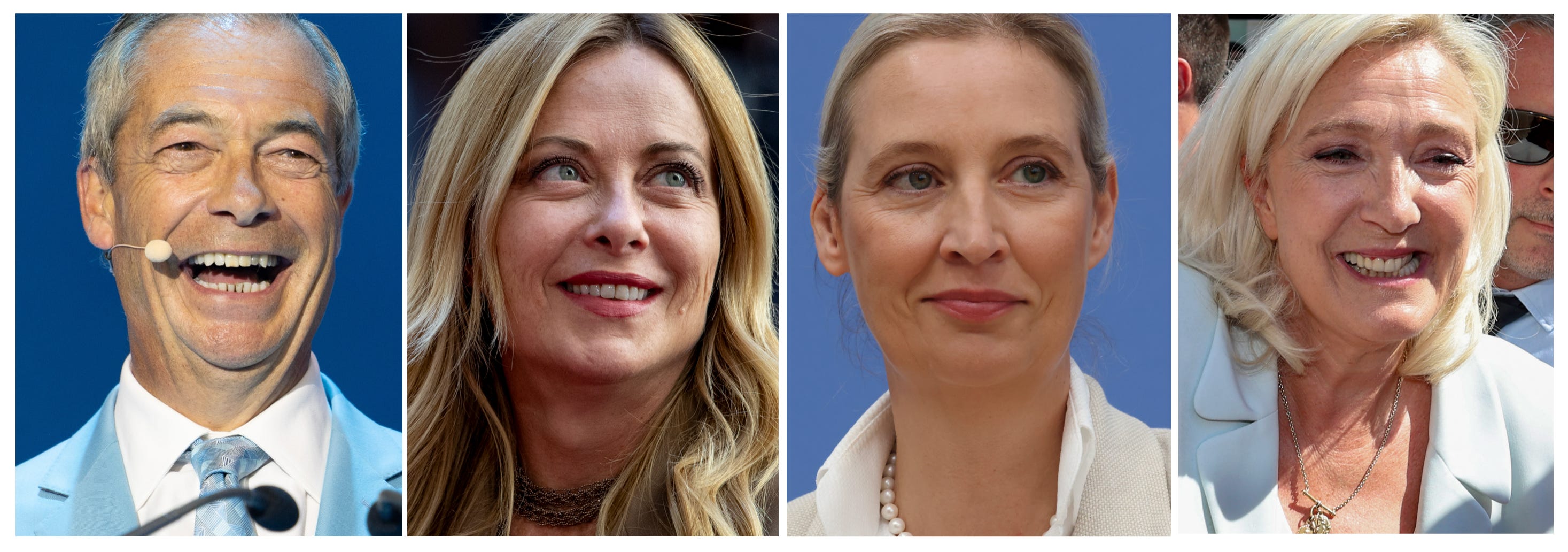
Political parties that oppose mass migration are “far-right,” according to most of the mainstream news media. The Associated Press reported on Sunday that “the far-right Alternative for Germany was projected to win a strong victory in a regional election,” and characterized the party as “anti-migration and Russia-friendly.” Reuters called France’s presidential front-runner the “far-right candidate Marine Le Pen.” AP described Italian Prime Minister Giorgia Meloni as “the head of a far-right party” who “backs curbing migration and promoting traditional values.” Euronews labeled both her Brothers of Italy party and Matteo Salvini’s League as “far-right.” Others describe Reform UK as a “far-right political party” and call its head, Nigel Farage, “leader of the far-right, anti-immigration party Reform UK.”
The label implies that these parties are fascist, but by the standards of scholars who study fascism, they are not. Roger Griffin, who wrote in 2020 that members of the International Association of Comparative Fascist Studies had “broadly adopted” his definition of fascism as “a revolutionary form of ultranationalism,” said in the same interview that “none of the leaders of illiberal democracies are actually fascist,” and that the danger of parties like the Rassemblement National “is precisely that they are NOT fascist.” Tim Bale of Queen Mary University of London noted that the term “far right” is a “loaded, weaponised term” likely to “cause confusion and controversy in equal measure.” Even Gideon Rachman of the Financial Times, who is hostile to rightwing populists, admitted in 2024 that “if a party pushes policies that liberals regard as unpleasant, reactionary or even racist but does that within the framework of democratic politics and the rule of law, the term ‘far right’ may no longer be appropriate.” And Rachman said Meloni “to date has looked like a relatively conventional conservative in power.”