


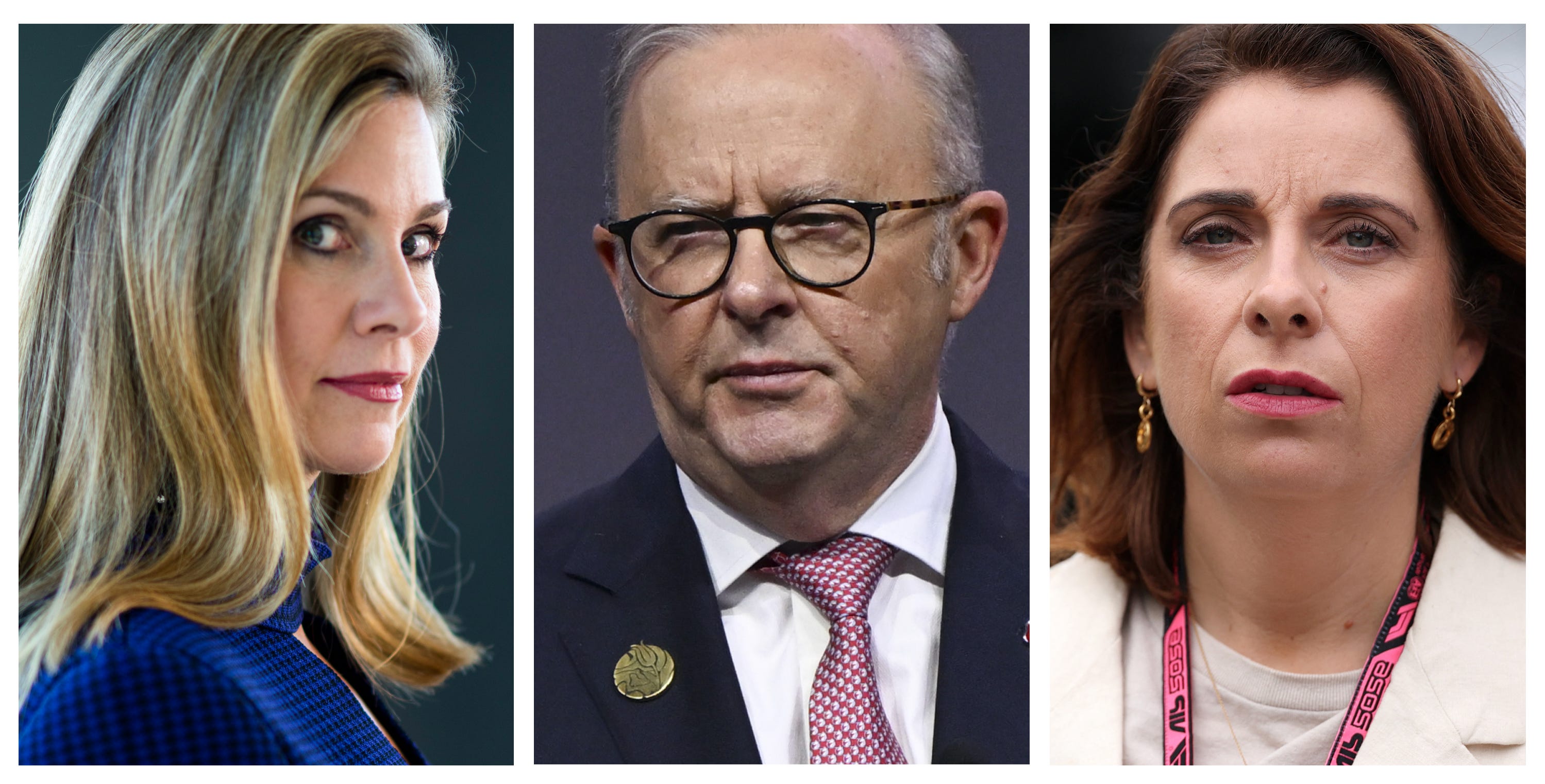
In September 2025, top government censorship officials from Europe, the UK, Brazil, California, and Australia met at Stanford to discuss ways to coordinate censorship at an international level. The meeting was titled “Compliance and Enforcement in a Rapidly Evolving Landscape.” Australia’s top censor, eSafety Commissioner Julie Inman Grant, gave the keynote.
Though Grant did not provide her remarks to Public, previously she had told the World Economic Forum (WEF) that she was organizing censorship officials around the world because “we know we’re going to go much further when we work together with other like-minded independent statutory authorities around the globe.”
Inman Grant’s efforts appear to be coming to fruition in Australia, where the lower house has passed sweeping censorship and surveillance legislation that the Senate is now considering. The legislation would allow the Commissioner to monitor “lawful but harmful” speech.
Inman Grant, an American who once volunteered to a journalist that she turned down a job with the CIA, can already order a platform to reveal who is behind an anonymous account from anywhere in the world.
But the DDoC bill now before the Australian Senate would also let her use fake accounts that deceive users into thinking they are citizens and not government spies, record their legal speech, and give what she learns directly to Australia’s spy agencies. Those agencies could then share that intelligence with the FBI and other “Five Eyes” intelligence-sharing partners in the US, UK, Canada, and New Zealand.
The bill enables this by granting eSafety the ability to create an unlimited number of AI-generated “sock puppet” identities (effectively bots) under policies set “in consultation with the Commissioner of the Australian Federal Police.”
The private information that the Australian government could share with foreign intelligence agencies could include a user’s name, address, phone number, email, along with what the Privacy Act calls “sensitive information,” which includes political opinions, religious beliefs, sexual orientation, and health records.
The Institute for Public Affairs (IPA) first reported on the Privacy Act changes on Monday, and Network Affects noted last month that the new censorship legislation designates eSafety an “enforcement body” under the Privacy Act, expanding its ability to access personal information.
In 2013, documents released by whistleblower Edward Snowden revealed that British intelligence officials had allowed, as part of a secret deal with the U.S. government’s National Security Agency (NSA), for it to gather information on UK citizens who were not under suspicion of any wrongdoing.
The eSafety Commissioner could thus unmask anonymous accounts in the United States, France, or Germany, for example, that complain about controversial issues like mass migration, and report them and all of their private information to the FBI and European spy agencies.
“We have power to share with the AFP [Australian Federal Police]; we don’t have power to share with intelligence agencies at this time,” testified Heidi Snell, eSafety’s General Manager of Regulatory Operations,in October this year. “But the amendments would see us being able to share directly with those other government agencies,” she added.
Those agencies include the Australian Secret Intelligence Service (ASIS), Australia’s equivalent of the CIA; the Australian Security Intelligence Organisation (ASIO), which performs a role similar to the FBI’s domestic intelligence division; the Australian Signals Directorate (Australia’s NSA); the Office of National Intelligence (ODNI); the Department of Home Affairs (DHS); the Department of Foreign Affairs and Trade (State Department); the Department of Defence; and any other “Commonwealth entity.”
The DDoC Bill contains a provision that would put eSafety in the same legal category as the Australian Federal Police under the Privacy Act for “surveillance activities, intelligence gathering activities or monitoring activities.”
eSafety told Public in an email that information it sends to the police may include “the account names or the identity of the users who posted the material.” A Federal Police witness testified on Oct 21 that police can pass eSafety’s information to “our ASIO partners.”
The censorship bill would change Australia’s Privacy Act so eSafety could collect sensitive personal information, including political opinions, without users’ consent,a warrant or judicial oversight. To invoke this Privacy Act exception, it would only need to “reasonably believe” that the collection is necessary for its functions.